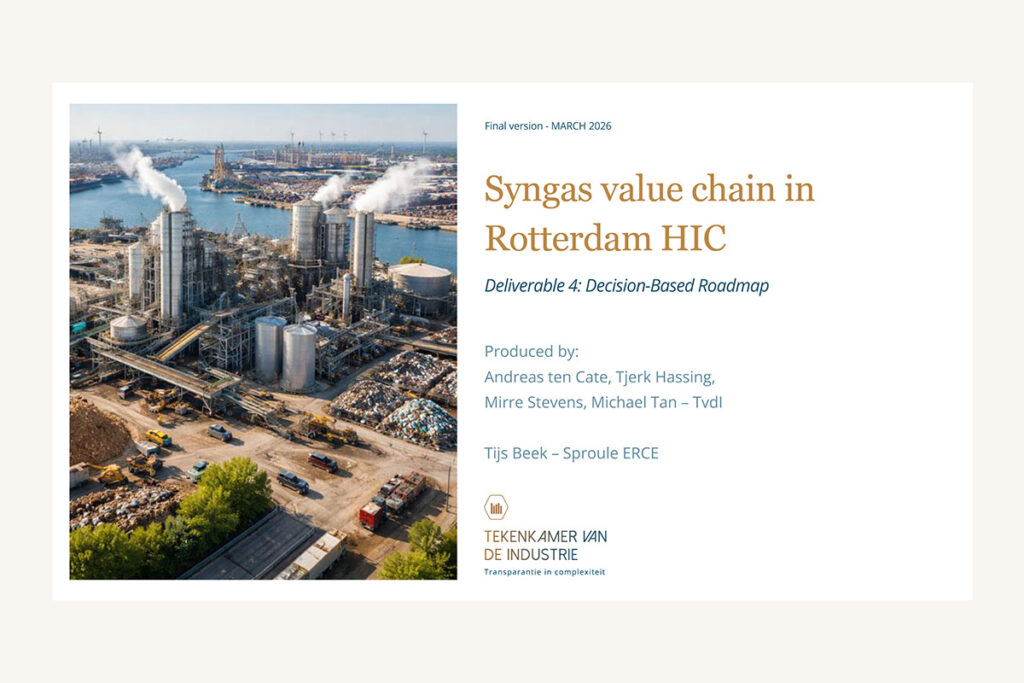
Syngas value chain in Rotterdam HIC – Deliverable 4: Decision-Based Roadmap
Problem Statement
Understanding what to build is necessary but not sufficient. Each development version requires a different sequence of decisions by different actors. A roadmap was needed that maps who decides what and in what order, and that tests the robustness of each version against geopolitical uncertainty.
Observations
Decision ownership shifts with scale. In Version 1, project developers lead and government supports. In Version 2, joint ventures between large industrials take the lead with active government backing. In Version 3, national government must initiate and coordinate before any other actor can commit.
Geopolitical stress testing sharpens the conclusion. Testing the versions against external forces including multipolar geopolitics, the accelerating energy transition, and EU internal dynamics reveals that Version 1 and 2 remain vulnerable to external shocks, while Version 3 is designed to withstand them through diversification and system integration.
The governance burden is version-specific. Supporting twenty distributed small projects may demand as much from authorities as coordinating one large national priority. The difference is that at Version 3 scale, this burden can be planned for and managed by design.
Conclusion
The decision-based roadmap shows that Version 3 delivers the highest value with the most manageable risk profile, provided sustained leadership and cluster-wide coordination are in place. The stress test confirms: Go Big or Go Home.
Scope
Decision mapping and geopolitical sensitivity analysis for three syngas development versions
Specifications
Report with decision roadmaps per version, KPI-based assessment (5 ambition + 4 risk indicators), geopolitical stress test against 3 driving forces