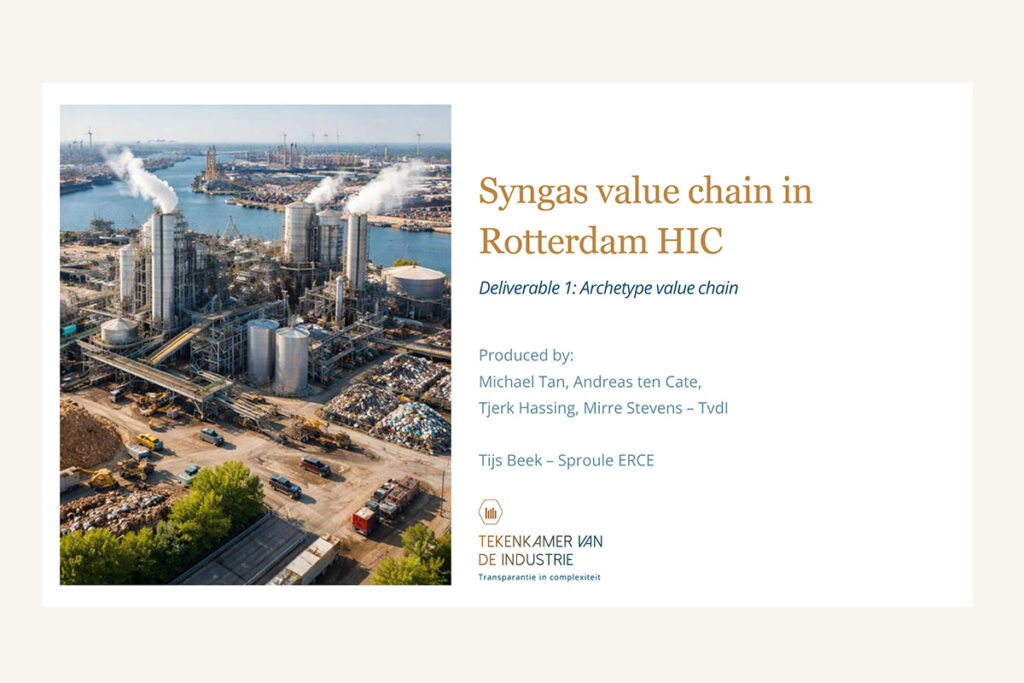
Syngas value chain in Rotterdam HIC – Deliverable 1: Archetypes
Problem Statement
Syngas can be produced from waste, biomass, plastics, and CO₂, and converted into methanol, synthetic fuels, and base chemicals. But no standardized reference existed for what a complete circular syngas value chain looks like from feedstock to product, nor what feedstock volumes the Rotterdam region could realistically supply.
Observations
Syngas is a uniquely flexible platform. It connects diverse carbon-rich feedstocks to a wide range of downstream products, making it a strategic building block for circular industry. This flexibility is not just technical but strategic: a syngas-based system can absorb feedstock uncertainty and serve multiple markets.
Feedstock availability sets the boundaries. Municipal solid waste, biomass, plastics, and CO₂ each have different supply volumes, logistics, and seasonal patterns in the Rotterdam region. The deliverable maps these availabilities to establish a realistic bandwidth for circular syngas production.
Archetypes enable strategic comparison. By defining standardized process blocks covering gasification, reverse water-gas shift, Fischer-Tropsch synthesis, and methanol production, the archetypes allow systematic comparison of different value chain configurations at different scales.
Conclusion
The archetype framework provides the foundational building blocks for assessing syngas value chain development at any scale, supported by an Excel model that enables quantitative exploration of feedstock combinations, production scales, and product portfolios.
Scope
Technology assessment and archetype definition for circular syngas value chains
Specifications
Technical report with archetype definitions, feedstock assessment, process descriptions, and accompanying Excel model