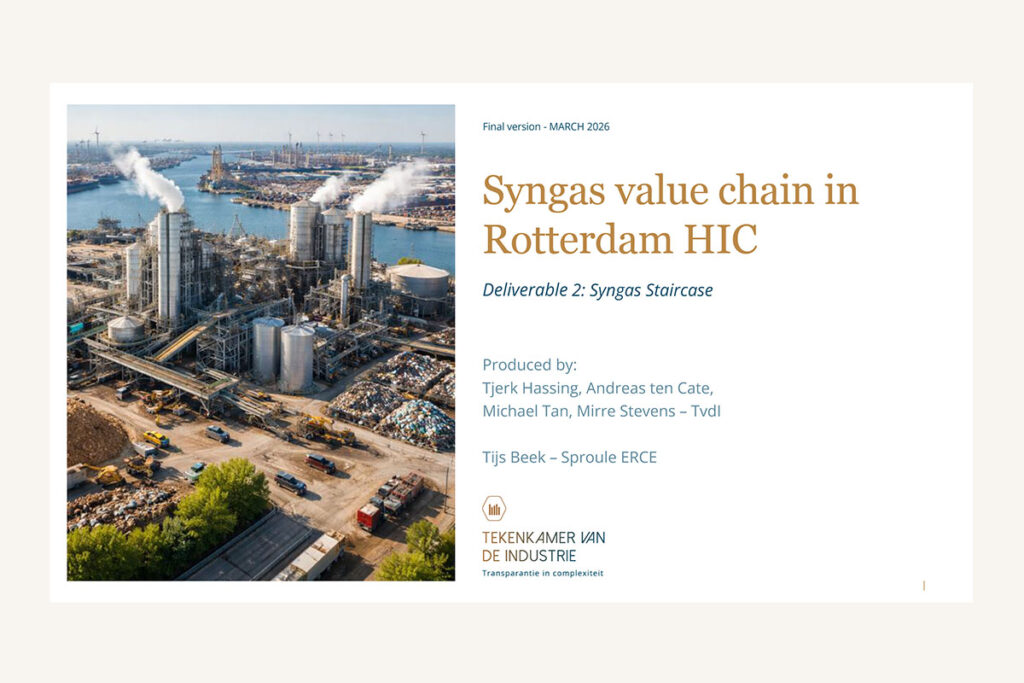
Syngas value chain in Rotterdam HIC – Deliverable 2: Syngas Staircase
Problem Statement
Circular carbon goals can be pursued at very different scales, each with fundamentally different consequences for assets, infrastructure, and the investment climate. A structured framework was needed to compare what different scales of syngas development require and what they deliver for the Rotterdam HIC.
Observations
Scale is not linear. Three versions at 100 kton, 1 Mton, and 10 Mton per year of renewable carbon were constructed as internally consistent development scenarios. Each implies a different asset model, different infrastructure requirements, and a different balance between domestic production and import dependency.
Implications cascade across the system. As scale increases, the decisions that need to be taken shift from project developers to national government. Infrastructure needs grow from local connections to cluster-wide networks. The investment climate must shift from project-level support to systemic coordination.
Space constraints and replication limits set ceilings. The number of projects that can realistically be sited in and around the HIC is physically constrained. Version 1 can reach 10-20 plants; Version 2 is limited to 2-6 large sites; Version 3 treats the cluster itself as the development unit.
Conclusion
The staircase framework reveals that choosing a scale is choosing a future. Small-scale development keeps us import-dependent; industrial-scale development reaches meaningful volume but with high continuity risk; cluster-wide development is the only path to strategic autonomy.
Scope
Scaling analysis comparing three development versions for syngas value chains in the Rotterdam HIC
Specifications
Analytical report with three version descriptions, impact assessment on assets, infrastructure, and investment climate, cost screening