Go Big
or
Go Home
Syngas value chains in the Rotterdam Harbor Industrial Cluster
Summary
The Rotterdam Harbor Industrial Cluster handles around 200 million tonnes per year of carbon-based materials, making it Europe’s largest carbon conversion hub. Reaching net-zero and circularity by 2050 requires replacing fossil carbon with renewable feedstocks at this scale.
After an earlier scenario study identified syngas as a key value chain, the Province of Zuid-Holland commissioned Tekenkamer van de Industrie and Sproule ERCE to explore what developing syngas-based value chains would require.
The study constructed three different development versions at 100 thousand, 1 million, and 10 million tonnes per year of renewable carbon. These are not sequential steps on a growth path, but different strategic choices with different consequences for who leads, what infrastructure is needed, and whether strategic autonomy can be achieved.
Through stakeholder interviews, technical analysis, and geopolitical sensitivity analysis, the exploration reveals that only a cluster-wide approach matches the scale of the challenge.
The cluster-wide path manages risk through phased coordination, delivers strategic autonomy, and keeps the cluster competitive. The conclusion: Go Big or Go Home.
Our approach
At the outset, an overview of past experiences and current technology expectations was lacking and scattered across stakeholders. We interviewed a broad selection of organizations on their views on the status and role of syngas in the Rotterdam HIC. In parallel we built archetype value chains and a basic mass-balancing model to compare them. These two ingredients formed the basis for the staircase versions. The interviews provided the insight to think beyond single value chains and consider the systemic role syngas can play. In a pivotal workshop with a subset of stakeholders and participants from the Province of South Holland, three groups each reasoned through a different version. As the results came together, the potential systemic impact of an expanded system across the Rotterdam HIC became clear. The final strategic analysis on decision-making and geopolitical robustness was built on this outcome.
Publications & deliverables
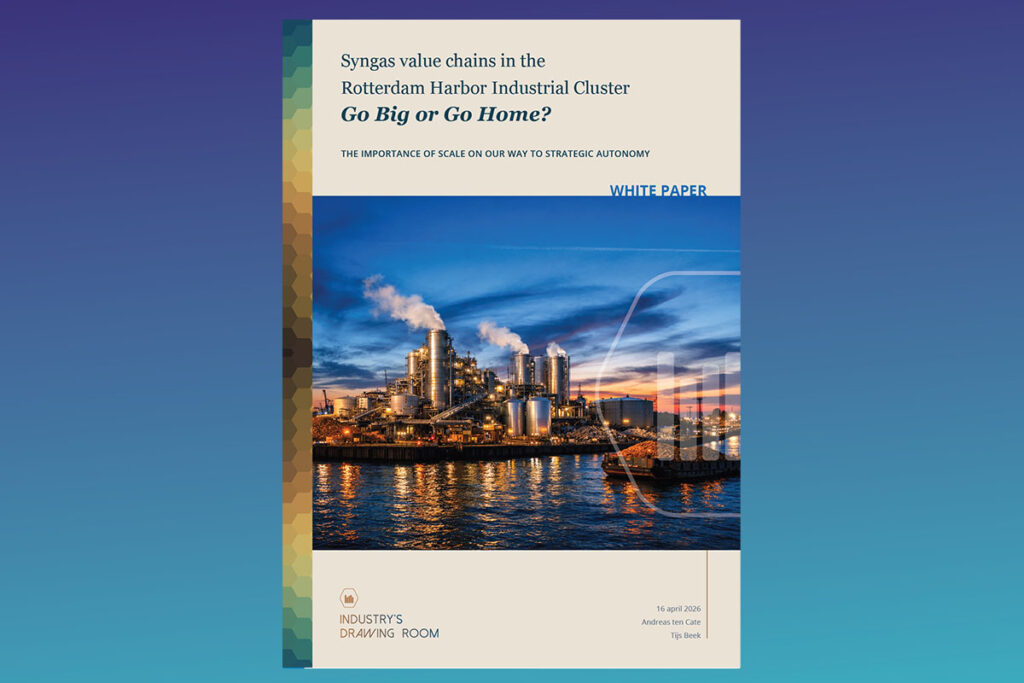
Syngas value chains in the Rotterdam Harbor Industrial Cluster – Go Big or Go Home?
This whitepaper summarizes the outcome of the syngas value chain project. Three different development versions were constructed, each defined by a different scale of development: 100 thousand, 1 million, or 10 million tonnes per year of renewable carbon. Analyzing the consequences of choosing a scale, and testing them against geopolitical drivers, shows that size matters. The paper takes the reader through the logic of scale, the realities of development, and the consequences of different choices, arriving at eight key messages and a set of recommended next steps for the Province of Zuid-Holland.
– Read the whitepaper
The conclusion of our analysis is underpinned in the four deliverables of the project, available as appendix to the whitepaper:
- Deliverable 1: Archetypes
Establishes archetypes of the circular syngas value chain: standardized representations of process steps, material flows, and conversion pathways from feedstock to hydrocarbon products. The deliverable covers syngas fundamentals, gasification of waste, biomass and plastics, and syngas production from CO₂ via reverse water-gas shift, and downstream conversions including Fischer-Tropsch synthesis, methanol production and methanol to hydrocarbons via Methanol-to-Olefins and Methanol-to-Fuels.
– download - Deliverable 2: Syngas Staircase
Constructs a staircase of increasing conversion scale to compare what different scales of syngas development require and what they deliver. Three internally consistent versions are defined: Version 1 (Circular Carbon Niche), Version 2 (Industrial Scale) and Version 3 (Renewable Carbon Megahub). Version 1 and version 2 represent two integrated value chains from feedstock to products, while version 3 represents an infrastructure-based development that integrates production and conversion between specialist sites across the cluster. For each version, the deliverable assesses implications for assets, infrastructure, and the investment climate, including a screening of cost, timeframes, and impact on multiple drivers.
– download - Deliverable 3: Staircase assessment by external stakeholders (pending)
Maps the stakeholder landscape across three domains: industrial assets, infrastructure, and investment climate. Presents key findings from interviews with a broad set of stakeholders on the current state of play for syngas in the Netherlands and the outcome of a stakeholder workshop held in January 2026 at the Province of Zuid-Holland to assess the staircase versions.
– download - Deliverable 4: Decision-Based Roadmap
Reviews how to come to decisions that lead to investments. It discusses the ambiguities that well-intended policy introduces when it is held against developing industrial scale value chains. It then discusses the structural differences through three decision-based roadmaps, that are assessed against five ambition KPIs and four risk KPIs, and challenged against geopolitical drivers. The analysis shows that Version 3, which matches inherent flexibility with scale, delivers the highest potential value with the most manageable risk profile, provided sustained leadership and cluster-wide coordination are in place.
– download
© Provincie Zuid-Holland, published by Tekenkamer van de Industrie. Licensed under CC BY 4.0.